
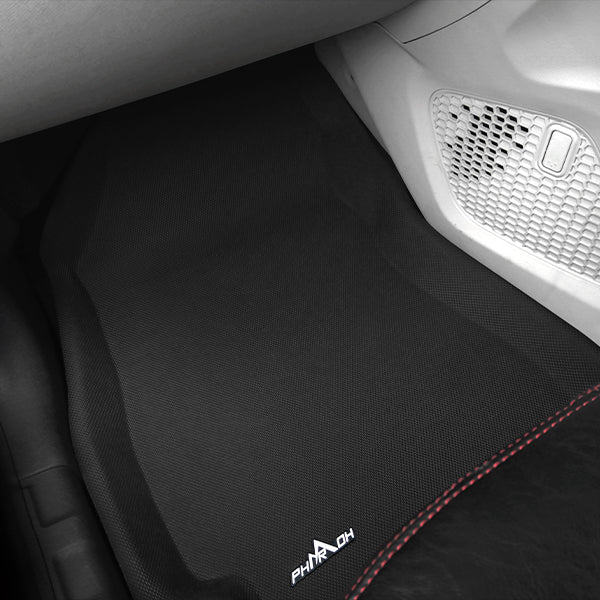
Walk into any car accessories shop in India and you will hear the salesperson confidently say "sir, yeh 7D mat hai" — as if the extra Ds are extra dimensions of protection. The truth is there is no industry standard that defines what 3D, 5D, or 7D means in the context of car floor mats. These numbers are marketing labels invented by manufacturers to justify higher prices. What actually matters is the material, the waterproofing quality, the fit, and how long the mat lasts on Indian roads. This guide cuts through the noise and gives you the real comparison so you can spend your money wisely.

What Does the "D" Number Actually Mean?
The D in 3D, 5D, and 7D is supposed to stand for "dimensional" — as in how closely the mat conforms to the floor of your car. A flat mat that just lies on the floor with no raised edges might be called 2D. A mat with raised side walls that cup around your foot area is marketed as 3D. Anything beyond that — 5D, 7D, 9D — is pure marketing invention with no universally agreed-upon definition.
Here is the core problem: a mat labelled 7D made from cheap PU foam with a fabric top is genuinely inferior to a well-made 3D mat made from food-grade TPE (Thermoplastic Elastomer). The number tells you nothing about the material, the actual fit to your car's floor contours, the edge height, or how it will hold up after two monsoon seasons. Shops use higher D-numbers to charge more money. That is the entire story.
When comparing mats, ignore the D-number. Ask these questions instead: What material is the mat made from? How high are the edges? Does it clip to the OEM anchor pin? Is it genuinely waterproof or just water-resistant? What is the expected lifespan? Those answers separate good mats from expensive-looking ones.
The Real Difference: TPE vs PU Foam
The most important variable in any car mat is the base material. Almost every mat sold in India falls into one of four categories: rubber, PVC, PU foam (often used in so-called 7D mats), or TPE. Here is what you need to know about each.
Rubber mats are the cheapest option. They are heavy, they crack in extreme heat (Indian summer temperatures can push interiors past 60°C), and they retain a strong chemical smell that takes months to fade. They offer basic protection but do not conform to the floor's shape.
PVC mats are lighter than rubber but share the same core problems — they crack in heat, emit chemical odours, and are not food-safe. PVC is also not recyclable in most facilities.
PU foam mats — the material used in most mats sold as 7D — look premium because they have a thick, spongy feel and often come with a fabric or leatherette top layer. The problem is that PU foam is not waterproof at its core. Liquids seep through the top layer and get trapped in the foam, creating a breeding ground for mould and bacteria. PU foam also compresses permanently over time. After 18 to 24 months of daily use, the mat loses its shape. The top fabric layer traps mud and dust and is difficult to clean thoroughly. Anyone with young children or pets in the car should be particularly cautious about PU foam mats for this reason.
TPE (Thermoplastic Elastomer) is a completely different category. It is a single-material, non-porous construction — there is no foam layer for liquids to penetrate. Spill a full bottle of water, mud, or chai on a TPE mat and it pools on the surface, held in by the raised edges. You pick up the mat, rinse it under a tap, and it is clean in under two minutes. TPE is food-grade — the same material standard used in food packaging and children's toys. It is odourless from day one. It is rated to perform from −40°C to 80°C without cracking or deforming, which means Indian summer heat is not a problem. TPE mats typically last 8 to 10 years compared to 2 to 3 years for PU foam.
Waterproofing: The Test That Matters Most for Indian Roads
India has one of the most punishing climates for car interiors in the world. The monsoon brings mud, wet shoes, and standing water. Summer brings dust that settles into every surface. Winter in north India brings morning dew and the occasional muddy boot. A car mat that is merely water-resistant fails this test — it slows the absorption but does not prevent it.
The waterproofing test is simple: pour 200ml of water on the mat and wait 10 minutes. On a PU foam mat, you will see the water slowly absorbed into the foam. On a TPE mat, the water sits exactly where you poured it, contained by the raised edges. Pharaoh's 3D mats feature 20mm raised edges — that is two centimetres of wall around the perimeter of the mat, enough to contain the kind of puddle that forms when you get into your Creta during a Bengaluru monsoon downpour.

Cost Over 5 Years: What You Actually Spend
The price tag on a so-called 7D mat set often looks attractive — ₹1,200 to ₹1,800 for a full set from a roadside shop. But the lifespan of those PU foam mats is typically 18 to 24 months before they start to compress, tear at the edges, or develop a permanent odour from trapped moisture. A TPE mat set from Pharaoh starts at ₹2,699 and is rated for 8 to 10 years.
| Factor | PU Foam "7D" Mat | Pharaoh TPE 3D Mat |
|---|---|---|
| Initial price (full set) | ₹1,200 – ₹1,800 | From ₹2,699 |
| Average lifespan | 18 – 24 months | 8 – 10 years |
| Replacements over 5 years | 2 – 3 sets | 0 replacements |
| Total cost over 5 years | ₹3,600 – ₹5,400 | ₹2,699 |
| Waterproof (100%) | No — water absorbs into foam | Yes — pools on surface |
| Odour | Chemical smell for 2–3 months | Odourless from day one |
| Safe for children and pets | Not food-grade rated | Food-grade TPE |
| Temperature performance | Deforms above 50°C | Stable −40°C to 80°C |
| Custom fit | Semi-universal | Model-specific, clips to OEM pin |
The Safety Factor Nobody Talks About
There is one comparison that goes beyond cost and material quality: driver safety. A mat that slides forward under your feet is not just annoying — it is dangerous. It can jam under your brake pedal or accelerator. Cheap universal mats and most 7D mats rely only on their own weight or a simple rubber underside to stay in place. Pharaoh's driver-side mat is designed to clip onto the OEM anchor pin that is built into your car's floor — the same anchor point the factory mat uses. This means the mat cannot slide forward, regardless of how hard you brake. The underside also features an anti-slip textured surface as a secondary retention system.
The Verdict
"7D" is a marketing number. The mat underneath that label is almost always PU foam with a fabric top — a construction that absorbs moisture, compresses over time, and costs more to own over a five-year period than a TPE mat. A quality TPE mat correctly labelled as 3D will outperform any PU foam mat on every metric that matters: waterproofing, lifespan, odour, safety, and total cost of ownership.
When you are buying floor mats, do not count the Ds. Ask what the mat is made from, how the edges are constructed, and whether the driver's mat clips to the OEM anchor. Those three questions will tell you everything the D-number never could.
Frequently Asked Questions
Is 7D better than 3D in car mats?
No. The D-number is a marketing label with no industry-standard definition. A 3D mat made from food-grade TPE is genuinely superior to a 7D mat made from PU foam in every measurable way — waterproofing, lifespan, odour, and safety. Focus on material and construction, not the number.
What does 3D mean in car floor mats?
In most contexts, 3D refers to a mat that has raised edges or walls that conform to the three-dimensional shape of your car's floor — as opposed to a flat mat. However, manufacturers use the term loosely and it does not guarantee any specific quality standard.
Are 7D mats waterproof?
Most 7D mats are not 100% waterproof. They typically use a PU foam base with a fabric or leatherette top. Liquid eventually seeps through the top layer and is absorbed by the foam, where it gets trapped and can cause mould. TPE mats are non-porous and genuinely waterproof.
How long do 7D car mats last in India?
In Indian conditions — heat, monsoon moisture, and heavy dust — PU foam 7D mats typically last 18 to 24 months before the foam compresses, edges tear, or the mat develops a permanent smell. TPE mats like Pharaoh's are rated for 8 to 10 years.
Do 3D car mats fit all cars?
Only if they are custom-made for your specific model. Generic 3D mats are cut to an approximate shape and will not fit properly. Pharaoh's mats are built for 80+ specific Indian car models — including the Hyundai Creta, Mahindra Scorpio N, Tata Nexon, Maruti Baleno, and more — using precise floor measurements for each variant.
If you drive a Hyundai Creta, Mahindra Scorpio N, or any of 80+ popular Indian car models, you can browse Pharaoh's full range at our 3D car floor mat collection or learn more on our floor mat guide page. All orders ship free across India and dispatch within 1 to 2 business days.
Frequently Asked Questions
Is 3D or 7D mat better for Indian roads?
3D TPE mats are better for Indian roads. They are 100% waterproof, odourless, and last 8-10 years. 7D PU foam mats look premium but absorb water during monsoons, develop musty odours, and need replacement in 2-3 years.
What does 7D mean in car mats?
7D is a marketing label with no standardised definition. It typically refers to mats made from multiple layers of PU foam and fabric. The number does not indicate quality, waterproofing, or fit - the material is what matters.
Can I wash a 7D car mat with water?
You can rinse the surface, but 7D PU foam absorbs water and takes hours to dry - often trapping moisture that leads to mold and odour inside the mat. 3D TPE mats rinse clean in minutes because the material does not absorb water at all.
How long do 3D car mats last compared to 7D?
Pharaoh 3D TPE mats are designed for 8-10 years. 7D PU foam mats typically last 2-3 years in Indian conditions before the foam degrades and the fabric top begins peeling.
Which car mat is truly waterproof?
3D TPE mats like Pharaoh are genuinely 100% waterproof - the TPE material does not absorb water at all. 7D PU foam mats are not waterproof despite what sellers may claim - the foam core absorbs and retains moisture.
Share:
Best 3D Car Floor Mats in India 2025: Complete Buyer's Guide