
Every car accessories shop in India — online or roadside — sells car floor mats. Amazon.in alone lists thousands of options, ranging from Rs 399 to Rs 15,000. The salespeople and product listings all use the same words: 3D, custom fit, premium, waterproof. So how does a Hyundai Creta owner actually know what they are buying? This post maps the real market: four distinct categories of car floor mats sold in India, what each one actually delivers, and where Pharaoh sits relative to each.
This is not a post written to put competitors down. It is written because most floor mat listings in India deliberately avoid disclosing what the mat is made from, because transparency would expose the gap between what is claimed and what is delivered. We will use publicly verifiable information throughout.

The Four Categories of Car Floor Mats Sold in India
Strip away the marketing language and you will find four categories of car floor mats in the Indian market. Each has a different material, a different price bracket, and a different set of real-world failures.
Category 1: Budget Universal Mats (Rs 400 – Rs 1,500)
These are the mats sold by hundreds of generic brands on Amazon, Flipkart, and roadside shops. Common brand names include MAK, Otoroys, Stinzo, Autofrill, and dozens of others that appear and disappear seasonally. They are almost always manufactured in China and sold under Indian labels.
Material: PVC coil (the plastic grass-mat texture), low-grade rubber blends, or cheap carpet fabric. Some are labelled "7D" despite using basic foam and PVC construction.
Fit: Universal. They are cut to generic size categories — small, medium, large — rather than to your specific car's floor dimensions. This means gaps at footwells, around the tunnel area, and at door sills. A universal mat typically covers 65 to 70 percent of your car's floor area, leaving the remaining 30 to 35 percent of original carpet exposed.
What buyers report: Amazon review patterns for this category are consistent. The top complaints are: a strong chemical smell (from PVC off-gassing) that can last weeks, water running off the mat edges onto the carpet because the edges are too flat, the mat slipping under foot, and durability issues within 6 to 12 months. Several Team-BHP forum members have documented the smell problem requiring weeks of sunlight exposure and baking soda treatment to partially eliminate.
Lifespan: 6 to 18 months in typical Indian use before cracking, fading, or smell becomes unacceptable.
Category 2: "5D/7D" Mid-Range Mats (Rs 1,600 – Rs 7,000)
This is the segment that has grown fastest in India over the last five years and caused the most confusion. Brands like AutoFurnish, Elegant Auto Retail, Speedwav, Carmate, and many smaller sellers offer mats labelled 5D, 7D, or 9D at this price point.
Material: Layered construction with PU (polyurethane) foam as the core, topped with leatherette, polyester mesh, or fabric. Some versions add an EVA (Ethylene Vinyl Acetate) layer. The number — 5D, 7D — refers to the number of layers, not any performance specification.
Fit: Many in this segment are genuinely model-specific and cover the floor well. The shape is correct — the fit problem is in the material, not the dimensions.
The core problem with PU foam: PU foam is porous. When rain water, a spilled drink, or wet footwear gets on the mat, the liquid seeps through the top leatherette layer and into the foam core. Inside the foam it cannot evaporate quickly because the leatherette traps it. In Indian monsoon conditions — where multiple wet-entry events happen daily — the foam stays moist. Within 6 to 12 months this produces a characteristic musty smell that cannot be washed out. The foam also compresses permanently under daily pressure, losing its shape.
Carmate (Japanese brand, available from Rs 700 to Rs 6,000 on Amazon.in) uses a 7D construction with leatherette on top and full-Velcro base. The Velcro base keeps the mat in position, which is a genuine feature. However, the foam construction has the same moisture problem as other 7D mats.
AutoFurnish carries an extensive range — over 100 car models, prices from Rs 1,000 to Rs 12,590 — but does not consistently disclose the material composition across its listings. This makes it difficult for buyers to compare accurately.
Lifespan: 2 to 3 years in Indian conditions before permanent odour or foam compression becomes a replacement trigger.
Category 3: Premium Imported Mats (Rs 9,800 and above)
The clearest example in this segment is 3D Kagu (also sold as 3D MAXpider in international markets), distributed in India by 3dmats.in. These are widely respected on car enthusiast forums including Team-BHP.
Material: A proprietary blend described as TPR (Thermoplastic Rubber) combined with XPE (Cross-Linked Polyethylene) foam and a MAXpider anti-slip fibre backing. This is a significantly better construction than standard PU foam — XPE foam is denser, more moisture-resistant, and does not compress as quickly.
Fit: Digitally measured for specific car models. Coverage is comprehensive across 800+ global models, though Indian model coverage depends on whether Kagu has scanned the local variant of your car.
What they do well: Team-BHP members who have used Kagu mats report 10+ year lifespans with no significant degradation. The carbon-fibre texture finish is premium. Anti-damaging fibre backing means no carpet marks.
The problem: A Kia Seltos complete set costs Rs 12,500 on 3dmats.in. A Toyota Innova or Mahindra Scorpio N set is Rs 13,000 to Rs 15,000. For many Indian car owners this is simply not a practical purchase when the car itself was bought as a daily-use vehicle.
Lifespan: 8 to 10+ years for the XPE/TPR construction. Genuinely long-lasting.
Where Pharaoh 3D Car Floor Mats Fit Into This Market
Pharaoh's 3D car floor mats use food-grade TPE (Thermoplastic Elastomer) — a material that is in the same premium, non-porous category as the imported Kagu mats. TPE does not have a foam core, there is no layered construction for liquid to seep into, and the material does not absorb water or odours. It is the same material standard used in food packaging and children's toys, which is why it is called food-grade.
The critical point is the price. Pharaoh's 3D mat for the Kia Seltos is Rs 8,499 — a complete custom-fit set that looks and performs identically to the Kagu at Rs 12,500. That is Rs 4,000 saved on a single purchase, with no compromise on material quality, waterproofing, or lifespan. On a Hyundai Creta, Tata Nexon, or Maruti Suzuki Brezza, the saving follows the same pattern.
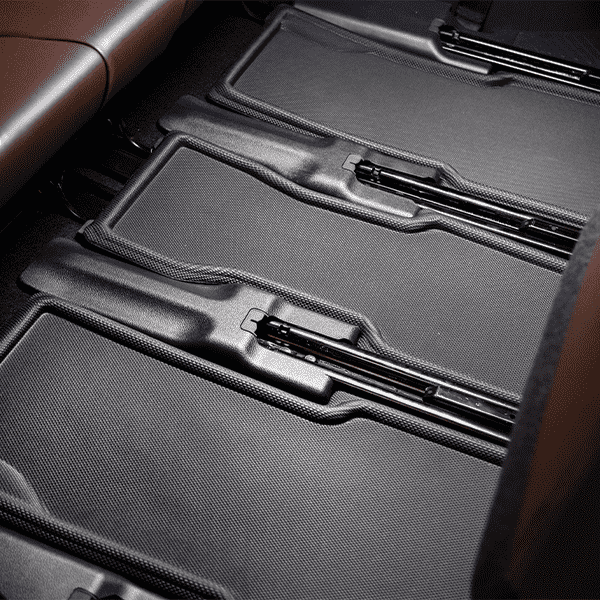
The visual finish is the same: deep-channel 3D moulding, raised edges, a clean black surface that wipes down in seconds. There is no cosmetic difference that justifies the import premium. The difference that matters — food-grade TPE versus XPE/TPR blend — is one of material specification, and both are in the same non-porous, waterproof, odourless category.

Real Model Price Comparison: Pharaoh vs 3D Kagu
| Car Model | 3D Kagu (3dmats.in) | Pharaoh 3D TPE | Saving |
|---|---|---|---|
| Kia Seltos | Rs 12,500 | Rs 8,499 | Rs 4,001 |
| Hyundai Creta | Rs 12,500+ | Rs 7,499 | Rs 5,000+ |
| Tata Nexon | Rs 9,800+ | Rs 6,499 | Rs 3,300+ |
| Mahindra Scorpio N | Rs 13,000–15,000 | Rs 8,499 | Rs 4,500+ |
Note: Kagu prices from 3dmats.in at time of writing. Pharaoh prices from pharaohautomotive.com. Same premium TPE-category material, same custom fit, same 8-10 year lifespan — different price because Pharaoh is made in India, not imported.
Direct Comparison: Pharaoh vs the Full Market
| Factor | Budget Universal (Rs 400–1,500) |
7D PU Foam (Rs 1,600–7,000) |
3D Kagu Imported (Rs 9,800–15,000) |
Pharaoh 3D TPE |
|---|---|---|---|---|
| Material | PVC / rubber | PU foam + leatherette | XPE + TPR blend | Food-grade TPE |
| 100% Waterproof | Partial (flat, no edges) | No — foam absorbs water | Yes | Yes |
| Odourless | No — PVC off-gassing | No — develops musty smell | Yes | Yes — food-grade |
| Visual finish | Basic rubber / coil | Leatherette top | Premium carbon-fibre texture | Same premium 3D moulded finish |
| Custom fit | No — universal | Many are custom | Yes — digitally measured | Yes — digitally scanned |
| Driver anchor clip | No | Rarely | No (uses fibre backing) | Yes — clips to OEM pin |
| Raised edge height | Minimal | Variable | Custom contoured | 15–20mm (stated) |
| Temperature rating | Not stated | Not stated | Not stated | -40°C to 80°C |
| Expected lifespan | 6–18 months | 2–3 years | 8–10+ years | 8–10 years |
| Price (Kia Seltos) | Rs 800–1,500 | Rs 2,500–5,000 | Rs 12,500 | Rs 8,499 |
Why Pharaoh Costs Less Than the Imported Alternative
The price difference is not a quality difference — it is a supply chain difference. 3D Kagu is a US-origin product sold via an Indian distributor. The Rs 12,500 price includes import margins layered on top of the manufacturing cost. Pharaoh is made for the Indian market, designed around Indian car models, and sold directly to the customer without import overhead.
Both use non-porous, waterproof, odourless materials rated for 8 to 10 years. Both are custom-fitted to your specific car model. Both look the same: deep 3D moulding, raised edges, a clean finish that wipes down in under a minute. The Rs 4,000 difference on a Kia Seltos set is entirely import premium.
What Pharaoh Does Not Claim
Honest marketing requires stating limits as clearly as strengths. Three things worth knowing:
3D Kagu covers more models globally. Kagu's international catalogue lists 800+ car models. Pharaoh covers 80+ Indian car models. If you drive an imported or low-volume model not in Pharaoh's range, Kagu may be your option.
Pharaoh is not the cheapest first price. If you only need floor protection for 12 months — perhaps for a car you are selling soon — a Rs 900 budget mat does the job. Pharaoh's value is long-term ownership and material quality, not lowest initial cost.
Speedwav and some Indian brands also offer custom 3D mats. Where Pharaoh differentiates is the explicit food-grade TPE material disclosure, the OEM anchor clip for the driver's mat, and the stated temperature rating — specifications most competitors in this segment do not publish.
The One Question That Tells You Everything
Before buying any car floor mat in India, ask the seller one question: What is the mat made from — the actual material name?
If the answer is "7D" or "5D" or "premium" or "leather-finish" without naming the base material, that is your answer. A seller confident in their product will say "food-grade TPE" or "XPE foam" or "natural rubber" — something specific that you can independently research.
Pharaoh's answer is food-grade TPE. That one answer determines every meaningful performance characteristic: waterproofing, odour resistance, temperature tolerance, and lifespan.
Frequently Asked Questions
Is Pharaoh the same quality as 3D Kagu/MAXpider?
In terms of material category — yes. Both use non-porous, waterproof, odourless materials in the premium TPE/XPE class. Both are custom-fitted to your specific car model. Both have the same expected lifespan of 8 to 10 years. The visual finish is comparable: deep 3D moulded channels, raised edges, a clean surface that wipes down in seconds. The difference is price: a Kia Seltos set costs Rs 12,500 at 3D Kagu versus Rs 8,499 at Pharaoh. That Rs 4,000 gap is import overhead, not quality.
How is Pharaoh different from Speedwav or AutoFurnish 3D mats?
Speedwav and AutoFurnish both offer custom-fit 3D mats at overlapping price points. The key difference is material disclosure: Pharaoh explicitly states food-grade TPE, a temperature range of -40 to 80 degrees C, and 15-20mm raised edges. Most Speedwav and AutoFurnish listings do not disclose the base material by name, making it impossible to verify waterproofing claims or predict lifespan. Pharaoh also includes an OEM anchor clip for the driver's mat — a safety feature most competitors in this range do not mention.
Are Carmate mats good?
Carmate is a Japanese brand with a legitimate quality heritage. Their Indian range uses 7D leatherette construction with a full Velcro base, which keeps the mat in position effectively. The limitation is the PU foam core, which absorbs moisture — a significant problem in Indian monsoon conditions. Carmate mats are a reasonable choice in the Rs 2,000 to Rs 4,000 range for buyers who prioritise brand trust over waterproofing performance.
What is the best car floor mat for monsoon in India?
For monsoon conditions, 100% waterproof construction is essential — meaning the mat material itself must be non-porous. TPE mats (Pharaoh) and XPE/TPR mats (Kagu) meet this requirement. PU foam 7D mats do not — the foam absorbs moisture through the seams. Rubber mats are surface-waterproof but typically lack deep enough raised edges to contain monsoon runoff. For Indian monsoon use, TPE or XPE-based mats are the correct choice.
Why do most car mats in India smell?
The smell in most Indian car mats comes from two sources: PVC off-gassing (budget mats) and PU foam absorbing moisture and developing mould (7D mats). PVC releases VOC compounds as it ages, particularly in summer heat. PU foam does not dry out fully between wet-entry events and develops a musty or mildew smell within months in Indian conditions. Food-grade TPE does not off-gas and does not absorb moisture, which is why TPE mats are permanently odourless.
Is Pharaoh available for my car?
Pharaoh makes custom-fit 3D floor mats for 80+ Indian car models including the full Tata, Hyundai, Maruti Suzuki, Mahindra, Kia, Toyota, Honda, Volkswagen, Skoda, MG, and Jeep ranges sold in India. You can find your car's specific mat at the Pharaoh 3D car floor mat collection. All orders ship free across India with dispatch within 1 to 2 business days.
Share:
What Are 3D Car Floor Mats? Everything You Need to Know