
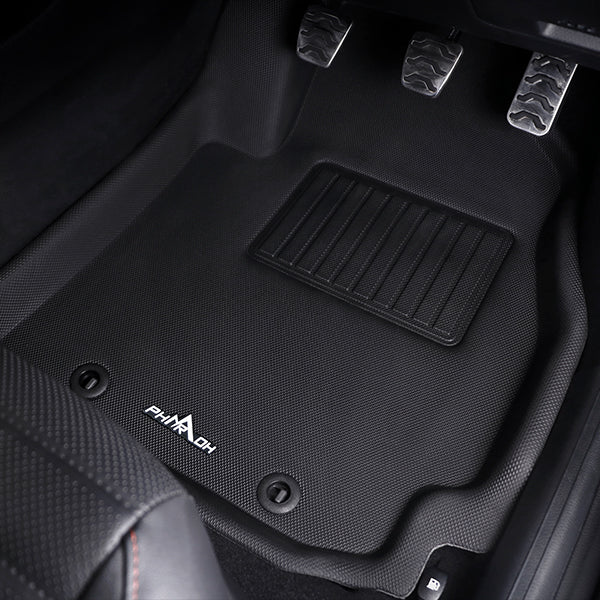
If you have started researching car floor mat options in India, you have almost certainly come across the term "3D car floor mats" — but most product listings do not explain what the term actually means, how these mats are made, or why they are worth choosing over the rubber or fabric mats that most Indian cars come with from the factory. This guide answers those questions from the ground up, covering the definition, the manufacturing process, the material science, why 3D mats suit Indian roads specifically, and exactly how to choose the right one for your car.

What Are 3D Car Floor Mats?
A 3D car floor mat is a custom-moulded floor covering designed to match the exact three-dimensional shape of a specific car model's footwell. Unlike a flat rubber mat or a generic carpet mat that is cut to an approximate size and laid on the floor, a 3D mat is manufactured to follow every curve, contour, and depression in your car's floor — including the raised transmission tunnel in the centre, the curved door-sill lip at the edges, and the varying depth of the driver's footwell versus the passenger footwell.
The "3D" in the name refers to this three-dimensional conforming fit. The mat does not lie flat like a sheet — it has raised side walls (typically 15mm to 25mm high) that run along the perimeter, turning the mat into a tray. Any liquid or debris that lands on the mat is contained within that tray and cannot escape to the original carpet underneath.
This is a fundamental difference from every other type of car mat. A rubber mat placed in the same footwell is flat — spilled liquid runs off the edges and soaks into the carpet. A fabric mat absorbs the liquid immediately. A 3D mat holds it on the surface, ready to be wiped away or drained when you remove the mat for cleaning.
How 3D Car Mats Are Made: The Manufacturing Process
The precision of a 3D car mat depends entirely on the accuracy of the measurements used to make it. Quality manufacturers — including Pharaoh — begin with a detailed measurement process for each car model they support. This involves either physically measuring the floor dimensions of the target car model or using digital scanning to capture the exact geometry of the footwell.
The key measurements include: the length and width of each footwell position (driver, front passenger, rear left, rear right), the height and angle of the transmission tunnel where it bisects the rear footwell, the depth differential between the flat floor area and the door-sill edge, the location and diameter of the OEM anchor pin hole on the driver's side, and the precise shape of any contour changes in the floor (wheel arch intrusions, wiring channel ridges, etc.).
These measurements are used to design a mould specific to that car model. The TPE material is then injection-moulded or compression-moulded into the mat shape, producing a finished piece that matches the floor geometry precisely. This is why a Pharaoh mat for a Tata Nexon petrol variant and a Nexon diesel variant may have slightly different dimensions — the floor shapes can differ between powertrains because of differences in the transmission and exhaust tunnel routing.
The surface texture — the hexagonal grip pattern, the carbon fibre-style texture, or the ribbed surface depending on the product line — is moulded directly into the mat surface during manufacturing. It is not a separate layer applied on top. This means the texture cannot peel, bubble, or separate over years of use.
What Is TPE and Why Does It Matter?
Most 3D car mats sold in India that are worth buying are made from TPE — Thermoplastic Elastomer. Understanding what TPE is will help you immediately identify whether a 3D mat is high quality or not, regardless of what the seller calls it.
TPE is a category of polymer materials that combine the flexibility of rubber with the processing advantages of thermoplastic. Unlike natural rubber, TPE does not require vulcanisation — the chemical curing process that makes rubber mats smell strongly and become brittle over time. Unlike PVC, TPE does not require plasticisers (the chemical additives that make PVC flexible but cause it to off-gas). Unlike PU foam, TPE is non-porous — it has no internal structure that can absorb liquids or trap bacteria.
The grade of TPE that Pharaoh uses is food-grade — the same material classification used for food packaging, kitchen utensils, and children's toys. This is a specific certification standard, not just a marketing claim. It means the material has been tested and confirmed to not leach harmful compounds even under heat stress. In a car's cabin where interior temperatures can reach 60°C to 70°C on Indian summer days, this matters. A food-grade TPE mat will not off-gas harmful compounds at those temperatures. A PVC mat or rubber mat will.
The practical results of TPE's material properties: temperature performance from −40°C to 80°C without cracking or deformation, zero odour from day one, 100% waterproof surface, lifespan of 8 to 10 years, and complete safety for children and pets who sit in the footwell area.
TPE vs Alternatives at a Glance
| Property | Rubber | PVC | PU Foam | Food-Grade TPE |
|---|---|---|---|---|
| Waterproof | Partial | Partial | No — absorbs liquid | Yes — 100% |
| Odour | Strong chemical smell | Strong plasticiser smell | Mild but present | None |
| Temperature range | Cracks above 60°C | Deforms above 55°C | Compresses above 50°C | Stable −40°C to 80°C |
| Lifespan in India | 2–3 years | 2–3 years | 18–24 months | 8–10 years |
| Food-grade safe | No | No | No | Yes |
| Custom moulding possible | Limited | Limited | Yes | Yes — high precision |
Why 3D Mats Suit Indian Roads Specifically
India's road and climate conditions are among the most demanding in the world for car interiors. Three factors make 3D TPE mats particularly well-suited to Indian conditions.
Monsoon moisture: India receives some of the heaviest monsoon rainfall in the world. The southwest monsoon delivers 600mm to 3,000mm of rain depending on region, from June to September. Getting in and out of a car during this period means wet shoes, wet clothing, and tracked-in mud on a near-daily basis. A flat mat with no raised edges allows this moisture to run off immediately onto the carpet. A 3D mat with 20mm raised edges contains it completely. Over a four-month monsoon season, the difference between a 3D mat and a flat rubber mat can be the difference between pristine original carpet and a mould-stained, deteriorating carpet that smells throughout the car.
Dust and fine particulate: Indian roads — particularly in north and central India — generate significant dust. Fine road dust settles into every surface of a car's interior. On a fabric or carpet mat, fine dust works into the fibres and cannot be fully removed even with vacuuming. On a non-porous TPE surface, dust sits on top and is removed with a damp cloth or a quick rinse. This is why cars with TPE 3D mats look cleaner inside after two years of daily use than cars with fabric or foam mats.
Extreme heat cycles: The daily temperature swing in Indian cars is extreme. A car parked in the open on a Chennai or Nagpur summer day heats to 60°C to 70°C by afternoon and cools to 25°C overnight. This thermal cycling is what causes rubber and PVC to crack over time. TPE handles these cycles without degradation because it is thermoplastic — it was designed to be processed with heat and retains its properties through repeated heating and cooling.

How to Choose the Right 3D Mat for Your Car
Choosing the correct 3D mat involves four decisions. Get all four right and you will have a mat that fits perfectly, lasts the full rated lifespan, and keeps your car's original carpet in showroom condition.
Decision 1 — Material: Specify food-grade TPE. Do not accept substitutes. If a seller cannot confirm the material is TPE, assume it is PU foam or PVC.
Decision 2 — Model specificity: Buy a mat made for your exact car model, variant, and year range. Pharaoh's product pages specify the exact compatibility for each mat — for example, the Tata Nexon mats cover specific year ranges and note any variant differences. Do not buy a mat listed as "fits most SUVs" or "compatible with multiple models."
Decision 3 — Edge height: Look for at least 15mm raised edges. Pharaoh's mats feature 20mm edges. Anything below 15mm will not adequately contain liquid from a significant spill or from a monsoon-wet shoe.
Decision 4 — Driver-side anchor clip: Confirm that the driver-side mat has a grommet or clip mechanism that attaches to the OEM anchor pin in your car's floor. This is a safety requirement. A mat without this feature should not be used on the driver's side regardless of its other qualities.
How to Install 3D Car Floor Mats
Installation takes approximately 5 minutes for a full set. Remove the existing floor mats from your car. Start with the driver-side mat — locate the OEM anchor pin on the floor (it is a small metal or plastic stud, usually visible after removing the factory mat). Align the grommet on the new mat with the anchor pin and press firmly until it clicks into place. Ensure the mat sits flat with no curled edges. Place the front passenger mat in position — it sits without a clip on most models. Place the rear mats last, tucking the front edge under the front seat runners if required for your model. The complete set should cover the entire cabin floor with no gaps.
Frequently Asked Questions
Are 3D car floor mats worth the extra cost over rubber mats?
Yes, when measured over the full ownership period. A rubber mat costs ₹300 to ₹600 but needs replacement every 2 to 3 years. A Pharaoh TPE 3D mat set costs ₹2,699 and lasts 8 to 10 years. Over 8 years, the rubber mat option costs more and provides significantly worse protection for the original carpet.
What is the difference between 3D and 5D or 7D car mats?
The D-numbers beyond 3D are marketing terms with no industry-standard definition. What matters is the material (TPE vs PU foam vs PVC), the edge height, the fit precision, and the anchor clip mechanism. A quality 3D TPE mat outperforms any 7D PU foam mat on every functional metric.
Can 3D car mats be used in any car?
Only if a model-specific version exists for your car. Pharaoh manufactures mats for 80+ Indian car models. If your model is supported, the mat will fit precisely. Universal 3D mats that claim to fit multiple models will not provide the same coverage or edge seal quality as a model-specific mat.
Are 3D car mats safe for children and pets?
Food-grade TPE mats are specifically safe for children and pets. The material is the same grade as food packaging and children's toys — it does not off-gas harmful compounds and is odourless. Rubber, PVC, and PU foam mats are not rated to this standard.
How do I know which 3D mat fits my specific car variant?
Check the product page for your car model and look for the year range and variant specifications. Pharaoh lists exact compatibility for each mat — including whether different variants (petrol/diesel, or different trim levels) share the same mat or require different versions. If you are unsure, contact the seller with your car's manufacturing year and variant before ordering.
Pharaoh Automotive, based in Bengaluru, has served 50,000+ customers across India with custom-fit TPE 3D floor mats for 80+ Indian car models. Complete sets start from ₹2,699 with free shipping and dispatch within 1 to 2 business days. Browse the full range at our 3D floor mat collection, or go directly to the Tata Nexon floor mats, Hyundai Creta floor mats, or Mahindra Scorpio N floor mats if you already know your model.
Frequently Asked Questions
What is the difference between 3D and 2D car mats?
A 2D mat is a flat mat that lies on the floor like a basic rubber doormat for your car. A 3D mat is moulded to follow your car's floor in three dimensions including raised edges of 15-20mm that contain spills and mud. 3D mats protect far more of the floor area.
Are 3D car mats universal or model-specific?
Quality 3D mats are model-specific - digitally scanned for your exact car. Universal 3D mats exist but leave gaps at footwells and door sills where dirt and water get through to the original carpet. Always choose model-specific mats for full protection.
What is TPE and why is it used in 3D mats?
TPE (Thermoplastic Elastomer) is a rubber-like material that can be precisely moulded, is 100% waterproof, contains no toxic compounds, and does not absorb odours. It is used in food containers and medical equipment - which is why it is called food-grade. It outperforms PVC and PU foam on every metric that matters for car floor mats.
Can 3D car mats be repaired if damaged?
TPE is highly durable and rarely needs repair under normal use. With an 8-10 year lifespan, most owners replace rather than repair if a mat sustains physical damage.
Do 3D car mats protect the original carpet?
Yes - completely. The full-coverage fit with 20mm raised edges means no mud, water, or debris reaches the original carpet. Maintaining the original carpet in good condition preserves your car's resale value significantly at trade-in time.
Share:
Rubber vs 3D Car Floor Mats: Which Should You Buy in India?
Pharaoh vs Other Car Floor Mat Brands in India: An Honest Comparison