
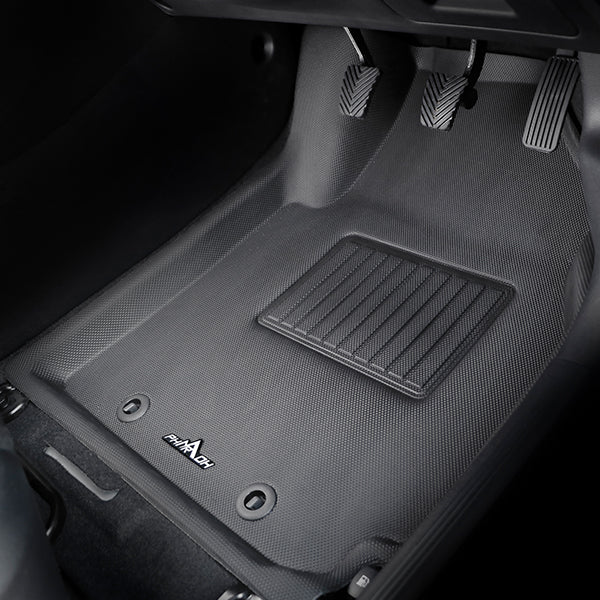
For decades, rubber mats were the default choice for Indian car owners — cheap at the local accessories shop, familiar, and seemingly practical. Then 3D car floor mats arrived in the market and the conversation got more complicated. Now you will see both sitting side by side at every car accessories stall, often at wildly different prices, with neither seller able to explain the difference beyond "yeh zyada achha hai." This guide gives you the complete, honest comparison between rubber mats and 3D car floor mats so you can make the right call for your car, your climate, and your budget.

Fit: How Well Does the Mat Actually Cover the Floor?
Rubber mats sold in India are almost always universal cut — a standard rectangular shape with a few cuts at the corners to accommodate the most common footwell shapes. The result is a mat that fits "most cars" but fits no car perfectly. On a Tata Nexon or Hyundai Creta, a universal rubber mat will not reach the outer corners of the footwell, will not conform to the transmission tunnel curve, and will leave visible gaps along the door-sill edge. Those gaps are where dirt and moisture funnel directly onto the original carpet.
Custom-fit 3D car mats are made differently. The manufacturing process uses digital measurements of each car model's floor — including the depth of the footwell, the angle of the transmission tunnel, the position of the door-sill lip, and the exact location of the OEM anchor pin. The result is a mat that sits flat without gaps, with 20mm raised edges running along the perimeter to form a continuous tray. On a Nexon or a Maruti Baleno, the mat covers the entire footwell from edge to edge. There is nowhere for spilled liquid or tracked-in mud to escape to the carpet underneath.
The difference in fit is visible the moment you lay the two mats side by side in the same car. The rubber mat will have corners that curl slightly, edges that do not meet the door sill, and a flat profile that does nothing to contain liquids. The 3D mat will sit flat, reach the edges, and form a raised wall around the perimeter.
Smell: A Bigger Problem Than Most People Expect
Rubber mats have a smell. Every Indian car owner who has bought new rubber mats knows the experience — you install them, close the car, come back an hour later in the summer heat, and the interior smells like a tyre shop. This off-gassing is from the vulcanisation compounds and processing chemicals used in manufacturing. In a car parked in direct sun with windows up — a situation every Indian car owner faces daily — interior temperatures can reach 55°C to 65°C. At these temperatures, rubber mats off-gas more aggressively. The smell typically fades after 4 to 8 weeks but never fully disappears, particularly on hot days.
PVC mats have the same problem, often more severe. The plasticisers used to keep PVC flexible emit odours that are more persistent than rubber and can include compounds that are concerning in an enclosed, heated space with children present.
Food-grade TPE mats are chemically different. They do not use vulcanisation agents or PVC plasticisers. They are manufactured to the same material standards as food packaging and children's toys — which means zero off-gassing and zero odour. Unbox a Pharaoh TPE mat and smell it. There is nothing. Install it in your car on a 42°C Bengaluru afternoon and the interior smells exactly the same as it did before. If you have young children or pets that ride regularly in your car, this distinction matters significantly.
Heat Resistance: The Indian Summer Problem
India's summer temperatures are extreme. Interior temperatures in a parked car in Delhi, Nagpur, or Chennai can reach 60°C to 70°C on peak summer days. Rubber mats begin to soften and deform above 60°C. After repeated cycles of heating and cooling through an Indian summer, rubber becomes brittle. Within 2 to 3 years, the edges of the mat will crack, the surface will develop small fissures, and the mat will start to break apart at stress points — particularly around any cutouts for the anchor pin or transmission tunnel.
PVC mats behave similarly — they soften and warp in heat, then harden and crack when the temperature drops. A PVC mat that has been through two Delhi summers will have permanent waviness from heat deformation and cracks along the edges.
TPE has a temperature rating of −40°C to 80°C. This is not a marketing number — it is the material's tested performance range. At 70°C interior temperatures, a TPE mat will not soften, will not deform, and will not crack. The same material performance continues in Shimla winters where temperatures drop well below zero. Over 8 to 10 years in Indian conditions — alternating between extreme summer heat and monsoon moisture — TPE maintains its shape and structural integrity.

Total Cost Over 8 Years: The Real Financial Comparison
Rubber mats look like the cheaper choice. At ₹300 to ₹600 for a full set from a roadside accessories stall, the initial cost is significantly lower than a ₹2,699 TPE mat set. But cost needs to be measured over the lifespan of the product, not just the purchase price.
| Factor | Rubber Mats | Pharaoh TPE 3D Mats |
|---|---|---|
| Initial cost (full set) | ₹300 – ₹600 | ₹2,699 |
| Average lifespan in Indian conditions | 2 – 3 years | 8 – 10 years |
| Replacements over 8 years | 3 – 4 sets | 0 |
| Total cost over 8 years | ₹1,200 – ₹2,400 | ₹2,699 |
| Carpet damage risk | High — gaps allow moisture penetration | Low — sealed tray with 20mm edges |
| Carpet replacement if damaged | ₹8,000 – ₹15,000 extra | Avoided |
| Odour | Chemical smell, especially in heat | None — food-grade material |
| Custom fit | Universal — gaps at corners and edges | Model-specific — full coverage |
| Temperature stability | Cracks above 60°C; brittle below 0°C | Stable −40°C to 80°C |
The numbers show that rubber mats are not actually cheaper over a car's ownership period. And they do not account for the risk of carpet damage — if moisture penetrates through the gaps in a rubber mat consistently over 2 to 3 years, the original carpet can develop mould, permanent stains, or structural damage. A full cabin carpet replacement on a mid-size Indian SUV like the Hyundai Creta or Mahindra Scorpio N costs ₹8,000 to ₹15,000 at a service centre. The mat that was supposed to save money ends up costing significantly more.
The Driver Safety Factor
This comparison has a dimension that goes beyond cost and material quality. Driver-side mat safety is a documented road safety issue in India and globally. A mat that slides forward under the driver's feet can partially or fully obstruct the brake pedal or accelerator. At highway speeds, a jammed accelerator or delayed brake response is catastrophic.
Universal rubber mats have no mechanism to stay in place on the driver's side. They rely on their own weight and their underside grip on the carpet. During hard braking — exactly when you need the brake pedal to respond without obstruction — the inertia of the mat can cause it to slide forward. Pharaoh's driver-side mat clips directly to the OEM anchor pin built into your car's floor, the same anchor point the factory mat uses. The mat cannot slide forward regardless of braking force. The anti-slip textured underside provides additional secondary retention. When you are evaluating mats for your driver's side, this is not a nice-to-have feature — it is a basic safety requirement.
The Verdict
Rubber mats are a 1990s solution that the Indian car accessories market has not yet fully moved past. They are cheap to buy, but they crack in heat, smell strongly, do not fit properly, and need replacement every 2 to 3 years. Over 8 years of car ownership, they cost more than a quality TPE mat set and provide significantly inferior protection.
Custom-fit 3D TPE mats are the correct choice for any Indian car owner who wants their car's interior to be in good condition when it is time to sell — and who wants the confidence that comes from a driver-side mat that cannot slide under the pedals. The ₹2,699 entry price for a complete Pharaoh set represents the better investment at every time horizon.
Frequently Asked Questions
Are rubber mats safe for the driver's side?
Universal rubber mats without an OEM anchor pin clip are a safety risk. They can slide forward under hard braking and partially obstruct the brake or accelerator pedal. Always use a mat with an OEM anchor pin grommet on the driver's side of your car.
Do rubber mats damage the original carpet?
Yes, over time. Because rubber mats do not have raised edges and do not fit perfectly, moisture and dirt work their way under the mat and into the original carpet. Repeated moisture exposure causes mould, permanent staining, and eventual deterioration of the carpet material.
Why do rubber car mats smell so strongly?
Rubber mats off-gas compounds from the vulcanisation process used in manufacturing. In a hot, enclosed car interior, these compounds become more concentrated. The smell typically fades over 4 to 8 weeks but can return on very hot days. Food-grade TPE mats do not have this issue — they are manufactured to odourless material standards.
Can I use rubber mats in summer in India?
Rubber mats work in summer but deteriorate faster in Indian heat. Repeated exposure to interior temperatures above 60°C causes rubber to become brittle over 2 to 3 years. TPE is rated to 80°C and maintains its flexibility and shape through multiple Indian summers.
What car models are 3D TPE mats available for in India?
Pharaoh offers 3D TPE mats for 80+ Indian car models including the Tata Nexon, Hyundai Creta, Mahindra Scorpio N, Maruti Baleno, Kia Seltos, Tata Punch, Hyundai i20, MG Hector, Tata Harrier, and many more. Each mat is made for a specific model and year range.
Ready to make the switch? Browse Pharaoh's complete range of 3D car floor mats at the HexLock floor mat collection. If you drive a Tata Nexon, go directly to the Nexon floor mat page. For the Hyundai Creta, visit the Creta floor mat page. Free shipping across India, dispatched from Bengaluru in 1 to 2 business days.
Frequently Asked Questions
Are rubber car mats safe?
Basic rubber mats are physically safe but have two concerns: the strong chemical smell from rubber compounds in enclosed cars in summer heat, and the tendency for the driver's mat to slide toward the pedals if it lacks an anchor. 3D TPE mats are odourless and include a driver's anchor clip.
Do rubber car mats smell?
Yes. All rubber mats have a chemical rubber smell. New mats smell strongly and the smell reduces over time but rarely disappears completely. This is particularly noticeable in summer when cabin temperatures are high. Food-grade TPE mats like Pharaoh are completely odourless.
How long do rubber car mats last in India?
Standard rubber mats last 1-3 years in Indian conditions before cracking. Indian cabin temperatures can reach 60-70 degrees C in summer, which causes rubber to harden and crack at the edges. TPE mats are rated to 80 degrees C and do not crack or deform.
Which is cheaper over time: rubber or 3D mats?
3D TPE mats are cheaper over 8 years. A single set of Pharaoh 3D mats (Rs 2,699-Rs 3,499) lasts 8-10 years. Replacing rubber mats every 2-3 years costs Rs 4,500-Rs 7,500 over the same period.
Can I replace rubber mats with 3D mats in my existing car?
Yes - it is a direct swap. Remove your existing rubber mats, place the Pharaoh 3D mats in position (they fit precisely without trimming), and clip the driver's mat to the OEM anchor pin. Takes under 5 minutes with no modifications to the car.
Share:
How to Clean 3D Car Floor Mats: The Right Way
What Are 3D Car Floor Mats? Everything You Need to Know